Things You Need to Know about MSG! — Is an article explaining about MSG and also to clear some myth regarding about this highly controversial food seasoning.
Eating is one of life’s pleasures. Taste and flavor are important to enjoying food. Think about a bowl of hot pasta with tomato sauce and parmesan cheese, a freshly grilled steak with a rich mushroom sauce, or stir-fried seafood and chicken with crisp vegetables in a savory sauce.
These subtle, delicate flavors result from centuries of culinary tradition, including careful attention to ingredients and preparation. In all of these dishes, glutamate is one of the major food components that provides flavor.
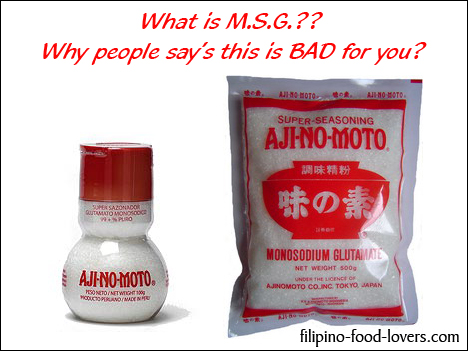
Monosodium Glutamate or/ MSG
What is Glutamate?
Glutamate is an amino acid, found in all protein-containing foods. Amino acids are the building blocks of proteins. This amino acid is one of the most abundant and important components of proteins. Glutamate occurs naturally in protein-containing foods such as cheese, milk, mushrooms, meat, fish, and many vegetables. Glutamate is also produced by the human body and is vital for metabolism and brain function.
What is Monosodium Glutamate?
Monosodium glutamate, or MSG, is the sodium salt of glutamate. When MSG is added to foods, it provides a similar flavoring function as the glutamate that occurs naturally in food. MSG is comprised of nothing more than water, sodium and glutamate.
Why is MSG used?
MSG is a flavor enhancer that has been used effectively to bring out the best taste in foods, emphasizing natural flavors. Many researchers also believe that MSG imparts a fifth taste, independent of the four basic tastes of sweet, sour, salty and bitter. This taste, called “umami” in Japan, is described by Americans as savory. Examples of each of these tastes are: Sweet – Sugar, Bitter – Coffee, Savory – Tomato, Sour – Lemon, Salt – Anchovy
How is MSG made?
In the early 1900s, MSG was extracted from natural protein-rich foods such as seaweed. Today, MSG is made from starch, corn sugar or molasses from sugar cane or sugar beets. MSG is produced by a natural fermentation process that has been used for centuries to make such common foods as beer, vinegar and yogurt.
How are Glutamate and MSG handled by the body?
The human body treats glutamate that is added to foods in the form of MSG the same as the natural glutamate found in food. For instance, the body does not distinguish between free glutamate from tomatoes, cheese or mushrooms and the glutamate from MSG added to foods. Glutamate is glutamate, whether naturally present or from MSG.
Glutamate Contents of Foods
| Food Size | Serving Glutamate (mg/serving) | |
| Tomato Juice | 1 Cup | 0.827 |
| Tomato | 3 Slices | 0.339 |
| Meat loaf dinner | 9 oz. | 0.189 |
| Human breast milk | 1 Cup | 0.176 |
| Mushrooms | 1/4 Cup | 0.094 |
| Parmesan cheese | 2 Tbsp | 0.047 |
| Corn | 1/2 Cup | 0.031 |
| Peas | 1/2 Cup | 0.024 |
| Cow’s milk | 1 Cup | 0.016 |
| Canned tuna (in water) | 1/2 Can | 0.008 |
Source: U.S. Food and Drug Administration
Does Glutamate or MSG improve flavors in all foods?
The natural flavor-enhancing levels of glutamate in food varies greatly, but is high in foods such as tomatoes, mushrooms and parmesan cheese. MSG enhances many but not all food flavors through the interaction between glutamate and other flavors. It works well with a variety of foods including meats, poultry, seafood and many vegetables.
It is used to enhance the flavor of some soups, stews, meat-based sauces and snack foods. MSG harmonizes well with salty and sour tastes, but does little for sweet foods such as cakes, pastries or candies. MSG can not improve bad-tasting food or make up for bad cooking. It does not allow a cook to substitute low-quality for high-quality ingredients in a recipe, and does not tenderize meat. It just makes good food taste better.
How is MSG used in the home?
When you buy MSG in the grocery store, you will find suggested uses on the container label. MSG is generally added to foods before or during cooking.
As a general guideline, about half a teaspoon of MSG per pound of meat or four to six servings of vegetables should be sufficient. Once the proper amount is used, adding more contributes little to food flavors.
How much Glutamate do people consume?
The average American consumes about 11 grams of glutamate per day from natural protein sources and less than 1 gram of glutamate per day from MSG.
This amount of added MSG is the same as adding 1 to 1.5 ounces of parmesan cheese. In contrast, the human body creates about 50 grams of glutamate daily for use as a vital component of metabolism.
Is MSG high in sodium?
No. MSG contains only one-third the amount of sodium as table salt (13 percent vs. 40 percent) and is used in much smaller amounts. When used in combination with a small amount of table salt, MSG can help reduce the total amount of sodium in a recipe by 20 to 40 percent, while maintaining an enhanced flavor.
Are people sensitive to MSG?
MSG is not an allergen, according to the American College of Allergy, Asthma and Immunology. The U.S. Food and Drug Administration has found no evidence to suggest any long-term, serious health consequences from consuming MSG.
It is possible that some people might be sensitive to MSG, just as to many other foods and food ingredients. There are some reports that mild, temporary reactions to MSG may occur in a small portion of the population, based on tests with a large dose of MSG in the absence of food. If you have questions about food sensitivities or allergies, contact a board-certified allergist or your personal physician.
Is MSG safe?
Yes. MSG is one of the most extensively researched substances in the food supply. Numerous international scientific evaluations have been undertaken over many years, involving hundreds of studies. The United States and other governments worldwide support the safety of MSG as used in foods.
MSG Safety
U.S. Food and Drug Administration (FDA): Designates MSG as safe (Generally Recognized as Safe/GRAS), with common ingredients such as salt and baking powder. (1958)
National Academy of Sciences: Confirms the safety of MSG as a food ingredient. (1979)
Joint Expert Committee on Food Additives of the United Nations World Health and Food and Agricultural Organizations:
Designates MSG as safe and places it in its safest category for food additives. (1988)
European Community’s Scientific Committee for Food: Confirms MSG safety. (1991)
American Medical Association: Concludes that MSG is safe, at normal consumption levels in the diet. (1992)
FDA: Reaffirms MSG safety based upon a report from the Federation of American Societies for Experimental Biology. (1995)
Is MSG safe for children?
Yes. Infants, including premature babies, metabolize glutamate the same as adults. Research has shown that newborn infants are able to detect and prefer the taste of glutamate. Glutamate is actually 10 times more abundant in human breast milk than in cow’s milk.
How can I tell if Glutamate or MSG is added to foods?
The U.S. Food and Drug Administration requires labeling of all ingredients on processed and packaged foods. When MSG is added to a food, it must be included on the ingredient list, as “monosodium glutamate.” Glutamate-containing food ingredients, such as hydrolyzed protein and autolyzed yeast extract, also must be listed on food labels. When glutamate is a component of natural protein foods, like tomatoes, it is not listed separately on the label.
This health education material has been reviewed favorably by the American Academy of Family Physicians Foundation.
Contact: the International Food Information Council (IFIC) and the IFIC Foundation:
1100 Connecticut Avenue, NW
Suite 430
Washington, DC 20036
202-296-6540 (phone)
202-296-6547 (fax)
http://www.ific.org
foodinfo@ific.org
 Posted in
  Tags:
Tags: 





I think you should consider this and similar websites:
http://www.truthinlabeling.org/WebIndex.html
The agencies you listed above do not have a vested interest in making sure the food supply is safe. One of the reasons you find so much MSG in just about any processed food is because it increases your appetite to an unnatural level.
It is true that MSG does occur natually in many foods, but if the foods are not tampered with then it will be in balance with other naturally occuring nutrients.
Assuming your right and MSG is harmless, you could still direct those who are nervous about MSG to a sight like this http://wiki.answers.com/Q/What_can_be_used_in_place_of_MSG. They would have to work out the substitutes themselves, but at least they would have the option.
May God be with you and have a nice day.
Whilst “there is no evidence that” (standard Government phrase – means it’s neither been proven nor disproven) MSG is harmful, there are many doubts when it comes to the safety and/or long term effects of consuming too much MSG.
My view on this is quite simple:
If you are a reasonably competent cook, using fresh, healthy and tasty ingredients, then YOU DON’T NEED TO USE IT!!!!!!
David Ray,
MSG is the most researched ingredient out there not only here in America also around the world.. The agencies mentioned above is the best one out there and not just any agencies that you never heard before.. Internet is a good source of information, but be careful there are a lot of false information also. FDA cannot banned anything base on false accusation.. Like what I said before if your concern about using MSG, then don’t use it, Period…
-Robert
Martin Brownson,
First off, Im pretty competent cook, but I do use MSG ever since I learned how to cook and my mother did the same thing and her mother’s mother… I never know anyone died or was seriously harm with MSG.. On your comments along with a lot of these agencies that claim MSG is harmful if you consumed “TOO MUCH”, guess what? They are right, the magic word is “TOO MUCH”. I guess they fail to mention if you use anything too much it will be harmful to anyone. Even plain water you could die from if you drink a massive amount of it. Common sense my friend, anything you use that is way more than the suggested amount is harmful…. People often look for a reason to blame anything other than themselves, the truth is if you want to be healthy, eat proper amount food and not too much then exercise a little bit..
-Robert
I was wondering why all the chinese/asian restaurants here in north america specifically advertise “no MSG”? I have chinese-filipino roots and as far as I know everyone uses MSG in china&Philippines maybe all over east asia… I heard that only caucasians experiences side-effects from MSG…is this true?
i have nothing against people who use MSG although if you use it , i won’t be able to eat your food. You so mentioned that MSG is not an allergen, yet here i am, and i’m allergic to it. I break out in rashes when i eat anything with MSG in it, so i DON’T get to enjoy much commercial food and i have to ask everytime i eat out if they use MSG in their cooking.
“There are some reports that mild, temporary reactions to MSG may occur in a small portion of the population, based on tests with a large dose of MSG in the absence of food.”
i found out about my reaction to MSG by eating food cooked with MSG, and yes i was tested for it. Because we used to disregard my symptoms as an allergy but then it acts up everytime i eat anything with MSG, instant seasoning, instant food mixes, even the instant noodles *sigh* so sad ..
Well me including friends has experienced headaches when eating high amounts of MSG. I dont respond to tiny amounts, but still i get headaches from big amounts. My sister is allergic to it too, headaches.
Great information! I’m linking to you and borrowing your pic for my blog, notanotheromnviore.blogspot.com. I’ve given you credit but if you have any issues with this just let me know!
NAOmni
A very interesting pro MSG article. You make an almost convincing case for it’s use but I have just one question: Is it necessary?
Personally I think not. Good quality ingredients, well prepared, well combined and well cooked simply do not need it.
I have a couple of friends who are talented professional chefs here in England, if anybody ever told them their food would benefit from adding MSG then I think they would give up cooking and become motorcycle repair guys!!!
i love filipino food and its better w/out SMG and im hoping that people who work always wrapped the hair so no one can get something on their food. i felt so sad because when i looked at my food their is a piece of hair on it” cleanliness is the best policy.”
i have to say no to MSG, MSG is like nicotine for food, it makes people addicted to the food. almost all the food products we buy from the store has MSG. companies put MSG in their product so people will choose their product. MSG is very bad for you. that is why we have organic stores, so that people that are health conscious and have knowledge about MSG has a choice than being stuck with the poison.. i mean MSG.. MSG is also a cause of being obese.. which makes sense couse it causes you to get addicted to eating. eating alot until your full is not neccesary, you should take your time and eat a small amount and apreciate the REAL flavor of the dish. if you want to enjoy the real flavor of what your eating, dont use MSG. to me, MSG only ruins the full potential of the flavor of a dish. dishes without MSG tastes better, and are better for you. MIGHT AS WELL THROW YOUR FOOD IN THE TRASH THAN USE MSG!!.. lol sorry,,, i just dnt like MSG. im a culinary student.. i wana make my future filipino restaurant MSG free so filipinos and the rest of the world will enjoy the real flavor of my dishes.
As far as I can remember, my parents and their parents, and their parents have used MSG in their lifetime. Im 35 years old now, and Im also using MSG on almost all my cooking. We never had any bad reaction from it. In contrast, my aunt who abstain from using it has diabetes, over weight and has food allergies too. I mean if its really bad for us, I just dont see it, or feel it for that matter.
nikolai reyes,
im a college student and im a serious health concious..for me “this msg your talking about”doesnt have to be use in any meals, this is just a “CHEATING”process so that people can get the taste they want!”
-nikolai.reyes@yahoo.com
~philippines
Interesting read. Now I have personally reduced my prejudice against MSG. Really enlightneing to know that it is safe. Another page added to my universal recipe Scribe Book!
Excessive usage of this one is bad for the health.
I believe that we can eat anything as long as the amount is limited….everything thats too much is dangerous..Discipline is the key for everything…doing good is very hard to do,but doing bad is easy to do,think about it?
Hi guys, whatever Robert Colinares was saying is, it is not harmful if you use it right.I believe of what he is saying. It is true that everything or anything or every food is dangerous or its not good anymore if you consume TOO MUCH. It is true….everything that’s TOO MUCH is dangerous. I am a Filipina and we use MSG until now, everybody’s saying that MSG is bad for you, yes its bad if you use TOO MUCH……………… Did you guys know if you drink TOO MUCH fresh milk is bad for you? Did you guys know if eat TOO MUCH ice cream is bad for you, if you eat TOO MUCH chocolate is bad for you?….. Robert Colinares was saying is if you use it wisely just the right amount its all good……. If you use too much yes its possible you can have headaches its the same when you eat TOO MUCH isn’t it you are having heartburn and you cannot breath? Am I right?….
anu ba namang mga ingles ito? sana tinagalog niu na lang lahat. gusto ko sanang pakinggan yung mga punto ng komento, hanggang sa nalimutan ko na.
friendly reminder for you guys, mag-ingles kung kaya itong pangatawanan at magtagalog na lang kung hindi.
my take on this topic is this: too much is really bad. sometimes i use it, sometime i don’t. if i see that my dish can stand on its own without using msg, i don’t bother shaking the msg into it. but sometimes, when i have guests with picky tastebuds, i put just enough amount to wow them. anyways, most of the time really we don’t need it. especially if you NEED to watch your calories. as one dietitian said, putting too much msg makes you EAT MORE,WANT MORE,CRAVE MORE as msg is like an addicting ingredient to any food, and that is a big problem lying using with too much of it.
MSG is ok. It’s oftentimes a state of mind that you get headache because of it. That’s bullcrap. It was tested on foodnetwork by reputable cook and host Ted Allen. they divided the crowd into 2 groups. they cooked and served the same food to the people only divided it, half had msg and was served to one group and the other half didn’t have msg and was served to the other group. after they’ve consumed the food, ted allen went up the stage and told everyone that some of the food served had msg but never divulged yet which group had it. and as expected, some reacted right away after hearing what he said. the big surprise? majority of the people that reacted saying they had slight headache belonged to the group that ate the food with no MSG. i am so pro moderation. i use MSG in all of my cooking and guess what, I am skinny and healthy and my husband is, too. we spice up our food to enhance the taste, right? it’s the same as salt or sugar for that matter. if u use too much of it, it’s disgusting. so, u guys can hate MSG for all I care. I mean it’s a free country. Robert is just posting something that is really enlightening and redeem MSG from being so underrated for heaven’s sake. for everyone that left negative comments, get over it.
nice article about protein…very informative thx
ty for posting this info, GB
LOL, talk about the biggest load of BS about MSG. Yeah ok glutamates in WHOLE FOODS are safe yes, because they are natural and in amounts required by the body with all of the other factors fromthe foods being consumed with them. However… the MSG they are talking about is processed identically to cocaine and affects the brain in the same manner. HELLO… this is a drug and whoever put this filth on the internet is also responsible for the promotion of a ‘Drug’ and will be held accountable for such in a higher court. I hope all who read this article on MSG ignore what it said and never eat this substance again.. it is not natural it is not necessary and it is a drug that is not safe for children. How do you think multinational food companies got a big as they did… adding an addictive drug to their food.
To Richard,
You’re a RETARD in the highest form. Are you talking out of your A**. I happen to agree with the writer (Robert Colinares) and Kudos for you sir for enlightening us with this article. Asian have been using this stuff for ages. I haven’t seen anyone having withdrawal symptom for without MSG in their food so, how could it be a DRUG. Go crawl back to the hole you got out of.
It amazes me how some people calls MSG drug, poison and most claims are if it’s use excessively…. Really?? EXCESSIVELY!!!! Water is pretty harmful, but if you have too much of it or EXCESSIVE amount guess what you can also die from it.
I heard all sorts of things about MSG, drug, poison, toxin… You know it won’t surprise me if someone post something here that MSG is being use to make bombs. Because that’s the only thing I have not heard yet!
NOTHING is good for you if you use it excessively. I had a friend that was telling me that MSG is poison and the funny part of this is she was smoking a cigarette and very disgusted while she was telling me about MSG.
Then when I ask her how many people does she know or heard of die from MSG? She can’t think of anyone or heard of anyone die from it. Then I ask her how many times did she hears people dies from lung cancer cause by a cigarette? She looks at me and shuts up…
The thing is if you don’t like MSG then don’t use it and if you happen to eat food with MSG in it, don’t worry you won’t die from it as matter of fact I would worry the amount of cholesterol, sodium, trans fat in them before I worry about MSG because those are the one that could actually kill you.
Bottom line is be responsible, watch what you eat and don’t eat too much of it and of course exercise regularly… I am bad at this myself, I need to diet and exercise too, but at least I don’t blame MSG for my excess weight. lol
First of all, it is not true that the body processes free glutamate the same way as bound glutamate. Most of the bound glutamate is used by the intestines for recovery. As for free glutamate, it is very toxic to the brain cells, specially if the glia does not have enough energy to process the glutamate-glutamine cycle. The person who wrote this article is clearly biased and does not know what he is talking about. Of course, all this doesn’t happen right away. But if you ask yourselves why alzheimers is so prevalent among older people, there you go! Since the discovery of MSG by the japanese researcher Kikunae Ikeda, the west has been using it EVERYWHERE to make people into buying fast food. Basically, you can put MSG in a piece of s*** and it will taste good. That’s maybe why your McDonalds taste so good… yummy… hmmmm maybe not so much, when you think about it…
Paulo,
I don’t have to think about this. All your accusations about MSG is baseless. My sourced is the Food Council and FDA if they were direct link and solid evidence that MSG is responsible for Alzheimer’s MSG would have been taken out of the market along time ago. And just for FYI, I don’t put important information on this website if its not from a reputable source. I sure like to know where did you get your information from? Is it from Wikipedia, drunk neighbor of yours or some doctor from some corner of the planet that no one have ever heard of? Also YOU CANNOT put MSG on SH*T and expect for it to be eatable the same as MSG “cannot and will not” save BAD cooking. MSG is an ingredient and it does not make BAD food taste better. So, if you’re going to post something like this on my website, PLEASE have something to back it up and “CITE” your sources and it better come from a reputable and not from unknown source or WIKIPEDIA…
you all should watch the documentary “The beautiful truth”
Lisa,
I saw that documentary before and as well as Food Inc. Both of them say don’t eat anything you can buy on the market. Grow your own food and not used any pesticides in them then you can assure what you’re eating is healthy.
I just want to say that MSG is the most highly researched food additives dating back decades and decades ago and despite all the finger pointing about how bad it is for our health FDA is still have not been able to remove it from the market. Why is that?
Do you want to know the answer???
Because they cannot prove that there is ABSOLUTE and SOLID EVIDENCE that MSG is the one to blame.
Take my advice…..
The used of MSG is not necessary and it is not needed. SO, if you wish not to use it then don’t use it or added to your food.
At that same token, I want you to know that it does not mean that you are not using MSG that impact you are avoiding it.
99.9% percent of what you eat contains MSG according to this site:
http://www.msgtruth.org/avoid.htm
With that said…. I will leave you the conclusion whether using MSG on your cooking matters or not.
I just want all of you to know that I am not “ADVOCATING” the use of MSG. However, I am not saying not to use it either. I do used it on my cooking if I feel it is necessary.
You will see MSG on a lot of my recipes, used it if you wish and if you don’t just simply omit it.
Cheers,
Robert Colinares
RIGHT ON BROTHER ROBERT,
We’ll said and that should be the end on this topic. I mean, millions of Asian folks can’t be wrong using MSG. Like you said, if you don’t want to use it, then omit from your recipe. Why argue and fuss about it, when we could be all brothers and sisters and live in peace and harmony. And that’s the thing about opinion, Opinion we all have it, just like a butthole. Men and Women of all race have butthole, So let us all stop on being A BUTTHOLE please. Now let’s move on and let our brother Robert continue sharing his love for cooking like everyone else that visits this website, peace to all you and more power to brother Robert for letting us visit your website for free. Most of all “God Bless You and All Your Love Ones”.
Thanks, Jerry! 🙂
http://www.naturalnews.com/024275.html
There has been quite a bit of research about the processes to create MSG – and it’s neurological impact. THIS site was the first I’d seen that gave an option to prevent the negative side effects. HTH
Hi Mary,
You know most people would believe anything they hear or read from the Internet. I understand the concern of most people about MSG, but give me a definitive answer that this people, groups of people or organization has a SOLID and strong evidence that MSG is impact bad for you!
Because if they do and they can actually make their case, this substance or toxin or poison as some people calls it wouldn’t be on the market. 98% of what we eat contains MSG either natural or artificial. So, if their accusation is true most of us would have been dead or have permanent brain damage along time ago….
Most of these people or groups that say’s MSG is bad for you is either selling their book about it or made documentary film about it and that very same facts question their credibility about the subject matter.
If you don’t want MSG you better plant everything your going to eat and don’t buy any commercially processed foods such as can goods, chips, or eat at any restaurant especially fast foods.
Don’t used tomatoes, dairy products such as milk, ice cream, cheese and the list goes on. Not meaning to rant about this, but I am getting sick and tired of people complaining about MSG.
-Robert Colinares
Hi Robert,
Thank you for writing an article about a subject which you obviously feel passionate. Yes, I agree, you have done good research. Having said that…!
I am a person who is highly sensitive to msg. I don’t know WHY I’m sensitive to it, but I am. Small amounts of msg can cause me to get extremely sick for days, larger amounts can make me sick for weeks or months. Obviously it is difficult to avoid. But I do cook everything that I eat myself. I eat mostly raw foods.
If I ingest a moderate amount of msg (two cupcakes made with a box mix) I am unable to stay awake for days. In addition, my head hurts horribly, my lymph nodes swell, and I can’t think at all. I just lie around until it passes.
It took me a long time to believe that this was the problem, but it happens every time, without fail. Even when I don’t know something has been cooked with msg, I have the same reaction. Always.
So please understand that the uproar about msg does have a basis in fact. There are many people like me who, for whatever reason, have a reaction to this substance. We’re not imagining it. Why the government hasn’t been able to see this, well… I can’t answer that. But these reactions exist.
Thank you for listening.
Hi Michele,
First, I want to thank you for taking the time to share your experience with my readers. Second, you have my sympathy regarding your reaction to MSG. I also want to say that I don’t think that your conditions doesn’t exist I am simply stating the fact that I cannot find any strong evidence that impact MSG responsible to what a lot of people accuse of it of. MSG as I mentioned from the previous post is the most researched food ingredient on earth.
Despite all of that they cannot make a direct link that MSG causes all the illness that they say. I just get really annoyed when people say’s it’s toxin or even poison I mean come on really? When was the last time did anybody knows and confirmed that someone had died from using MSG. What worse I have friends that gets so disgusted about MSG and yet they smoke cigarettes like a chimney.
I don’t doubt not even a single bit that you are telling the truth and I don’t doubt that you’re not alone with this reaction to MSG. Unfortunately, you’re reaction does not mean that MSG is really bad for you. Why you might ask? Well, there are a lot of people that cannot eat Peanuts their bodies react to so bad that there are some fatal cases because of it. Now, is this enough reason for the rest of us should avoid eating Peanuts? How about those people who is lactose intolerant, is this means that we should avoid or stop eating dairy products? Well, I am sure you can guess what my answer to that question.
Lastly, this is a recipe site and not a restaurant any recipes that my readers found on this site that contains MSG they can omit it from their cooking. I am not forcing nor convincing anyone to use MSG if you don’t want to use it then don’t use it and on your case you have every reason not to. One more thing for those who believe that MSG is bad for you and questions FDA’s integrity. Why don’t you also questions those people who says it’s bad for you, where they got their information from and how accurate it is? Even a documentary that is produced by a well-known network cannot be trusted on everything they say about MSG. Remember these people are selling this books or videos about it, so that makes their words and statements highly questionable….
Best of luck,
Robert Colinares
Hi Robert,
I see your point, and nicely stated.
Best regards,
Michele
My wife and I have really enjoyed preparing some of the recipes on this blog. They’re great. A note on MSG: Research has discovered that MSG can cause some people to experience headaches.
I have a severe sensitivity to msg. Anytime, and I mean every single time, I’ve eaten foods with msg it feels like my lips are on fire, my face flushes like I’ve taken a large amount of niacin, and my stomach let’s me know that it doesn’t like the msg as I projectile vomit. I gave up on eating out when it comes to any oriental food as the cooks don’t even know if their foods have msg in them. My son has the same sensitivity but his includes his throat swelling, he carries an epi pen just in case. I have benadryl liquid I have to carry as it gets so bad. But if you can stomach msg and you like how it enhances the flavor of your food I say go for it, as for me I’ll just skip that ingredient because it doesn’t detract from the recipes you’ve added here, they are great tasting even without the msg.