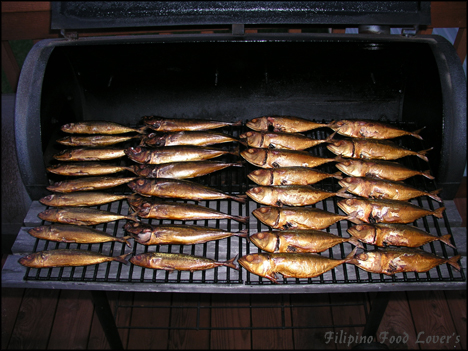
Now we’re going to talk about a dish that would make most Filipino’s mouths water even if they just smell it. Tinapa – Smoked Fish is a favorite and definitely very popular among Filipino’s. You will find this dish sold at street vendors all over the Philippines.
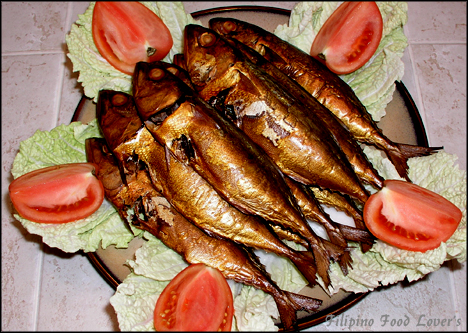
Tinapa / Smoked Fish
Tinapa or Smoked Fish – this dish is served at breakfast, lunch, and definitely around dinnertime along with tomatoes, onion on the side and garlic flavored vinegar for dipping sauce. This will surely bring out your appetite. Most western cultures might not agree, but for most Filipino’s it would be a homerun.
Here in the Midwest where I live finding a freshly smoked Tinapa is virtually impossible. What we have here is the frozen kind and it does not taste anywhere near as good as the fresh ones. So what do I do about it? I make my own!
Making Tinapa is a two-stage process, the brining part and the smoking part. Brining the fish gives it a good salty taste and also makes it moist. The smoking part cooks the fish and obviously gives it the smoky flavor.
Ingredients:
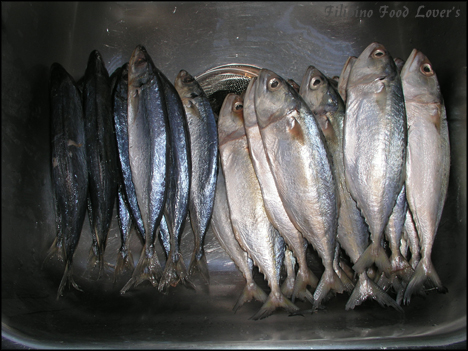
- 5 Lbs of Galunggong fish
- 1 Quart of Salt
- 3 Quarts of water
- 2 Lbs. of Hickory wood chunks for smoking
Directions:
Note: Soak wood chunks in water two days before using it.
For the Brine:
- In a large bowl or small bucket add warm water and dissolve the salt.
- Clean the fish and add the brine onto the fish.
- I just use our kitchen sink for this (make sure your sink is clean and rinsed thoroughly).
- Let it brine for 1 hour while stirring the brine every ten minutes.
- The rule of thumb: brine the fish for ½ an hour for every half inch (thickness) of fish.
- After an hour remove the fish from the brine, rinse it well, and set aside.
The Smoker:
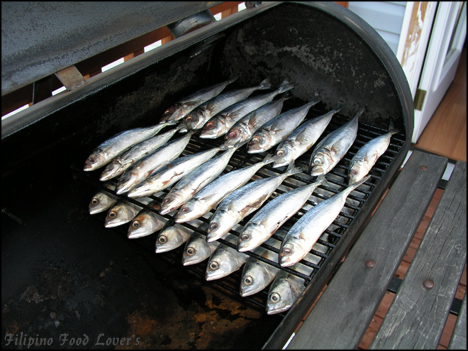
- Depending on your smoker, the best way to do this is to keep the fish away from the heat source as much as possible.
- Place your fish on the rack and add your wood chunks to the heat source.
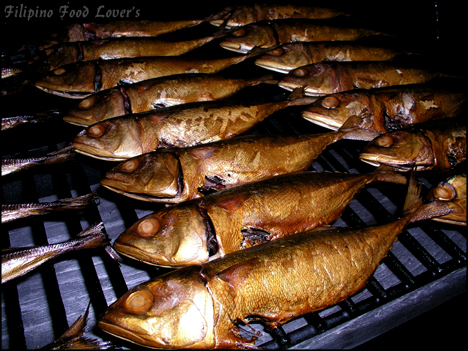
- Cover the smoker and let it smoke for 1 ½ hour.
- You will need to add wood chunks every 20 minutes to keep the smoke going.
- Enjoy your freshly made Tinapa.
- Serve with fresh tomatoes and onions and don’t forget the garlic flavored vinegar dipping sauce.
My Personal Story:
I had my fair share of making and selling these smoky delights when I was at my younger stage. When my family moved to the U.S., I was left behind for a year due to an immigration issue. Being by myself for the first time I got to do whatever I wanted and didn’t have to worry about what time I should be getting home. With that in mind my two cousins and I went for a visit to see another cousin, Jeffrey, who lives in Cavalan, which is a town right outside Olonggapo City.
Being young and dumb and not thinking ahead we went partying in Olonggapo where my cousin used to work. Needless to say our money was quickly exhausted and we soon realized that we didn’t have any more money left. So we went to see our uncle who also lives in Cavalan and happened to be a smoked fish vendor.
He told us he would let us sell some fresh, smoked, and dried fish if we wanted to. This was devastating news for me and my other cousins Michael, Rogel, and Jeffrey. We were teenagers and our main priority was impressing girls. Being seen with a bucket full of fresh fish yelling isda (fish) is the very last thing we had in mind.
But we didn’t have any other option so we sold fresh Galunggong (round scads) in the morning and the left over fish was transformed into Tinapa & Daing which we sold in the afternoon. Our first day we walked all morning and afternoon and only brought back 8 pesos each as our share.
We combined our money and purchased 1 kilo of rice, some eggplant, and other ingredients to make fish Adobo. (The fish was free) Of course I was the one who was elected to do the cooking. Along with that we also had enough money for the not so necessary things like 2 bottles of gin and 2 packs of Champion brand cigarettes. After supper we went off to play pusoy (poker) and drink our good stuff. Despite the long walk and a little embarrassment we we’re able to enjoy the evening and walk bare footed on the ground.
This was just several months after Mt. Pinatubo erupted so there was ashes and sand all over the place, which felt good to walk on. Even though we didn’t have television or radio at that time it was a stress free and enjoyable evening despite the fact that I was a lousy pusoy player.
Our bets we’re that the loser had to do the dishes and get water to drink. Lucky me, I wound up losing the bet and ended up doing that too. Many evenings followed and we did the same exact thing before going back to Manila.
We learn how to make Tinapa and Daing in the process and my uncle made a great Daing. It was not salty at all and the fish was still moist and soft. It was quite an experience for my cousins and myself and to be honest if I could go back in time I would do it again. Being a spoiled brat and basically getting what I wanted as long as we could afford it was sure a rude awakening for me. I learned my lesson the hard way about how valuable money is and how hard it is to earn it.
 Posted in





Your story about Tinapa inspired me and it brought back a lot of good ole memory from my childhood and in the Philippines. Thanks for sharing!
Jamie
Ahh! They looks so tasty! Awesome job here.
We hand catch fresh Galuggong daily for preorder customers that seek top quality fish. Our fish are not crushed by large nets but are caught carefully in cast nets in order to produce the best looking and eating product possible. We produce around 300 to 1000 pounds per 1 0 days but could increase production if need be.
We are seeking markets for are fish and looking forward to any preorders.
Thank You
Capt Rod
Fish Runners
farwaterref@gmail.com
850-774-8300
I liked your story, thanks for sharing the recipe on smoked fish, I will try that at home with my family when I visit them in June. I’m sure they’ll appreciate fresh smoked tinapa since all we get is the frozen kind from the Filipino stores.
Owen
I have a smoker and it has a water basin. In your procedure , you did not mention to add water in the basin. I guess my question is, do i need to use the water basin or not. THANKS
Christy,
If your smoker has water basin, then yes use it. That water will help keep your fish moist during smoking process.
-Robert
Hello Kabayan,
Do you know anybody who sells and delivers tinapa? So i can place an order and have it shipped to me? I love tinapa and i don’t have time to make it cause im living on-post and i work a lot.
Thanks,
Jenn
Ano po yung hikory sa tagalog, meron pa po bang ibang kahoy na pwedeng gamitin at saan kaya pwdeng makabili
Hi Jenn,
Where is your location?
Thanks,
I grew up in a fishing town (Davao Oriental) but for some reason people did not know how to make tinapa or smoke fish. When I was in college I had to go to the city, and my cousin offered me a smoke fish. I thought at first the taste wasn’t good but when I tried it I totally like it. I then introduced it to my mom when she came to visit me and she like it as well. Now I’m living in Massachusetts I do miss this kind of food. But I am not so sure if the frozen fish will taste ok. i would love ot try though on summer, problem is, we don’t have a smoker, we only have a gas grill, not sure if this would help. But Thank you so much for sharing this recipe!
i’m really interested to make tinapa, i bought smoke grill 7 yrs ago but i never tried to use yet,i’m hesitant because i dont know how to start and where to buy the smoke wook or any other flavor, please give me some idea about this. thank you. joy
hi! this is joy again, i just want to correct the smoke wood not wook. thanks
Thank you for sharing this recipe with us! My cousin and I just invested in a smoker and tried out a traditional ‘american fare’ that is usually smoked . . . ribs! It turned out REALLY good (I would say better than Lucilles!). . . Not bad for a couple of filipinos to be honest.
Next week I am definitely going to try out this recipe. However I have a few questions. Does hickory really give it that ‘traditional’ tinapa flavor? I live really close to the beach in California and here on the pier you can catch spanish mackeral. Can that be an alternative fish I can use or is round scad (galunggong?) the best way to go? I look forward to hearing from you.
Thanks again,
Ryan L.
Ryan,
Any wood that are used to smoked meat or fish would work. It does not have to be Hickory. I don’t really know about Spanish Mackerel much, but as long as they are about the same sized I suppose you can use it as substitute. The key on smoking fish is not to apply too much heat, you don’t want to dry your fish. I put water below my fish to keep it moist during the smoking process. Good luck on smoking your fish and let me know how it turns out.
Cheers,
Robert Colinares
Hi, thanks for this informative article. I am recently conducting research on the process of making smoke fish as a small business. Since I got a tight capital, I am searching for ways how to build improvised smoker. Guys, If anyone wants to help me, please send me mail at juliusam@yahoo.com or just reply this comment. thanks.
Hi, my wife is from the philippines (davao city) and she loves tinapa, I have never had it before, but I want to learn how to cook it the way she likes it, but she tells me the tinapa she likes is not really smoked fish, but dried fish. Is she just crazy or is there another recipe? lol. Im going to try your recipe here, it looks really good, I hope she likes it and Im sure I will, I love all smoked fish. Thanks for the recipe, I hope to see more!
Robert,
As far as I know Tinapa and Dried Fish is totally different process. However since your wife is from Davao they might call things differently locally? Dried Fish or “Daing” is process done without using heat, they are normally dried using sunlight and massive amount of salt to preserve the fish.
When I was in the Philippines I was shown by my uncle who used to owned and operate a Tinapa business how to make a Dried fish a different way. He butterflied the fish just like you would normally do on a Dried Fish, but he didn’t really smothered it with massive amount of salt, all he did is soak it on salt water for half an hour and sun dried it for few hours and that is it.
I must admit it’s has to be the best Dried Fish I ever had for the reason being the fish is still moist and not salty at all. The fish that he used was “Round Scad” it is known in the Philippines as “Galunggong”. Good luck on your fish smoking and let me know how it turns out.
Cheers,
Robert Colinares
Hey Robert great story..Would the teepee method work for tinapa? I have a fire pit in my backyard and I was thinking of tying 3 metal rods together to make a teepee, the fish will be dangling in the middle and i was planning to cover it up in either banana leaves or a tarp..Do you think that would work?
JON,
Your tepee idea should work, my only suggestion is to keep your heat low and put a pan filled with water between your heat source and your fish (see illustration below). This will serve two purpose, first it will tame the heat for you and the second it will help keep your fish moist during the smoking process. Make sure you tepee is big enough, so it won’t catch on fire. Good luck on your fish smoking and maybe send some pictures for other readers to see.
Best of luck,
Robert Colinares
Robert, thanks for your help. Can you let me know what the best way to add the wood chips? I’ve been told you don’t add the wood chips to the fire and that you need to place the wood chips on a grate above the fire. So with your illustration above do I add the grate above the water filled pan? .I’m pretty new to smoking as you can tell..Any suggestions would be most appreciative. Thanks again.
JON,
First I wouldn’t use wood chips. They are okay if you’re using in on a small grill or smoker, but not for your setup. I would strongly suggest that you use wood chunks.
Do the usual stuff, soak the wood chunks in water over night after that place the chunks directly onto the charcoal not on the crate and certainly not above the water pan.
Things to keep an eye to: don’t let the wood chunks catch on fire as they will intensify the heat and you’ll lose the smoke. No open flames, just red hot charcoal.
Once the wood chunks starting to catch on fire, remove it from the heat and soak it again on water and replace the one you took out with newly soak wood chunks. Add about 6 wood chunks at a time (3 to 4 inches in size).
The key to this is keep your heat low and smoked your fish heavily for an hour. After that you’ll have a great tasting Tinapa. 🙂
Again, good luck on your smoking and let me know how it turn out.
~Robert
Robert, the tepee experiment didn’t work. There wasn’t enough smoke so I ended buying a smoker just like yours. We’re going to attempt to smoke fish again this weekend. BTW at what temperature should I try to keep it at? Thanks again.
hi Robert,
Thanks for sharing!
Can I use steamer instead of smoker? we love tinapa
Leah
Jon,
Sorry, I wasn’t able to respond right away. I’ve been busy here lately with homework and other things. About the temperature I don’t have the exact number, all I can tell you is smoke it as low heat as possible, if you don’t your fish will be way too dry or burnt. Anyway good luck and keep us updated about your smoking adventure. 🙂
~Robert
Hi Leah,
I am afraid steaming will not work on this recipe, you have to have smoke and plenty of it in order to have Tinapa (smoked fish). Otherwise if you use steam all your doing is cooking the fish without smoke flavor. Good luck and god bless.
~Robert
Hello Robert, we tried smoking about 2 lbs of baby bangus(5 pieces) and 2 lbs of gg(8 pieces) trying to do it in 2hours, but it did not cook all the way..I had to smoke it for another 2hours to get the correct texture..I had it at low heat also. I’m not exactly sure what I’m doing wrong, but I’m cooking with a temp between 150-200 F..Do I need to intensify the heat to cook the fish under 2hours?
Hi Jon,
I smoked Galunggong and Alumahan and I only smoked it for an hour. I was not really concern about my fish being all the way cook for the reason being I pan fried my Tinapa before serving it.
I suppose you can increase the temperature to cook your fish all the way through. I would increase it to 300º degrees and check your fish after an hour to make sure it not being overly cook.
It sounds like you’re doing everything correctly, you just need to fine tune it to your liking.
~Robert
Robert I appreciate all your help. I will let you know how it turns out on monday . thanks
You’re welcome Jon! I’m glad I could help. 🙂
Is there any secret to make tinapa because I tasted once before it was so good,do you have any secret to make tinapa?
Rose,
There is no secret on making Tinapa. A good cool smoke is the key on making good smoked fish. The idea is to make as smokey flavor as you can without drying the fish. It does take some trial and error, but I wouldn’t call it a secret. Good luck! 🙂
-Robert
Quick question: How does the fish get its deep orange color? Is it just caused by the smoking process? I also saw another process done in Cawit Cavite, where instead of soaking fish in salt water, they actually boil it in the solution before rinsing with clean water prior to smoking. Check out this site:(http://www.marketmanila.com/archives/marketman-learns-how-to-make-tinapa-from-scratch) Does this produce the same result in taste and texture? Which process would be better?
Hi Ed,
The way they make their Tinapa is the way my uncle used to make them. Marketman was right that is basically what most Filipinos smoked their fish. I think the reason is quicker. You can definitely try that method too. If you read my story about Tinapa you will noticed that I used to sell it for my uncle who used to be a Tinapa maker in Cavalan a town outside Olongapo City.
We used to get the fish fresh from the vendor and we sell the fresh ones in the morning then we made Tinapa on left over fish. First we dry them on the sun for about an hour then we dip the fish into a boiling salty water for 2-3 minutes then onto the smoker. If I can remember it right we don’t really smoke it that long I’d say 30 minutes at the most. Then the cheat part, squirt it with some yellow food color. And that is it, they are ready!
My method I showed here is more western method, where you actually cool smoked the fish to me is taste better. The coloring you see is from the smoke I didn’t used any food coloring of any sort! Good luck on your smoking and let us know how it turn out for you!
P.S. I will be making a video on how to make Tinapa, so back check soon! 🙂
Cheers,
Robert Colinares
Hello Robert,
Is there a low sodium option for the brine?
thnx,
Glen
read your story.. and it was quite amazing
hi, i’m here in davao city, philippines and smoked fish are also seldom seen or sold here. from the province where i came from, coconut husk are used in smoking fish, sometimes mixed with fress bamboo stick to make the flavor more distinct.
Hello kabayan, i just did my first tinapa grill on my weber kettle with home made smokenator:
I used 5 lbs of red snapper. I Soaked it for 3 hours on brine solution (low sodium— 1/2 cup of salt, 1/2 cup of brown sugar, 1/4 cup of goya adobo mix, 1/4 cup TOYO, 1/4 cup of ground pepper, 1 bulb of garlic crushed or minced, 1 gallon of water, 2 lbs of hickory wood chunks. I wasnt able to soak the chunks for 2 days but while im preparing the temp on my kettle smokenator i did soak the wood on brine solution after i removed the fish (approx 30 min – 1 hour). When the temp on my kettle reached 180*F — probe of the thermo on the indirect heat side—direct heat side was about 200*F( with 16 briquettes of white hot coal under 16 non lit briquettes — approximation only—) prepare the fish and put it in the grate. You can use the brine solution placed in an alluminum tray for temp control and keeping the fish moist and juicy. Temp kept on fluctuating from 175-205. I cooked one side for 1.5 hours with 1 pound of wood chunks then flip the fish for additional 1.5 hours and use the remaining wood chunks and no additional briquetttes was required.
Id say, i pretty nailed it the first time. Next time i would be soaking the fish a little longer and will soak the wood for a day or two and smoke it 2 hours on each side. Or i would buy a WSM, it would be a lot easier to make some TINAPA. And ill make sure i will be cooking more rice, and will slice more tomatoes and onions, nabitin kami sa kanin LOL.
Hi PonziPilato,
That’s awesome. Actually, I was just thinking making some Tinapa tomorrow using my Weber Kettle grill. What a co-incidence, great minds think alike. 🙂
Anyway, salamat for sharing your cooking method and I am glad that it turn out good the first attempt. Keep sharing your cooking I like to hear more from you.
P.S. I had to re-sized your picture it was a bit big to fit on the page. 🙂
God Bless,
Robert Colinares
Salamat Bobby, actually the truth behind that “low sodium brine solution”, was i ran out of ASIN at TOYO. hehehe(pa-low sodium-low sodium pa kuno). The only left on my arsenal of seasoning was adobo mix and i dont wanna compensate it for salt fearing i might just spoil the TINAPA taste. Anyway, it came out good and tasted tinapa (hence the purpose of wood chunks). If you want it a little bit salty just dry rub salt on the fish after it has been soaked from.the solution.
Smoking in the kettle is a bit tricky, especially if you dont have the right equipment, but its no rocket science, i think anyone can figure it out once you truly are CRAVING for a filipino food like these 🙂
Pls do give some tips on attaining/maintaing 225*F Ifever you pulled it off. Honestly, i wasnt able to attain temp more than 205*F (probe on direct heat side — grate level but without touching the grate). On the indirect heat side, the most i got was 194*. Thanks and GOOD LUCK.
It’s Robert not Bobby. lol
Anyway, I smoked fish before using the same method you did and you’re absolutely right smoking a fish on a Weber Kettle is a bit tricky. The main problem is keeping the heat low where you don’t dry the fish since your heat source is really close to your fish.
I think you did great since you obviously succeeded on your first attempt. My only suggestion when your using a Weber Kettle is to choose a smaller fish where you don’t have to leave it in the smoker for a long time to achieve that smokey flavor.
I would say Galunggong fish would be a good candidate. As far as the heat goes the cooler the better since that is the key element to avoid dry smoked fish. Keep the smoke going while maintaining the low heat that way you can get the maximum smokey flavor and still have a moist fish.
Again, thanks for sharing and keep them coming. 🙂
-Robert
I just purchased some tinapa Round Cod and Milk Fish(Galungong/Bangus). It is raining here in Florida all day since yesterday. It brings back the good old days memories I had in my youth. All Filipino knows how it goes when rainy season. I wish to eat these food with family and friends I used to be with. I guest the reminices takes me back.
Hello all,
We lived in Sande-Pritil in Tondo right after the war where there were a lot of Umbuyans, so I think I know a little about Tinapa. We are now Floridians for the last 36 years. When I was younger we used to go fishing a ;lot , now only the young ones do.
Since we do not have the usual native things, we make substitutes.
Fish– Any oily fish is fine. Galunggong, Tunsoy or Hasa-hasa are the classics. Here we do Bluefish, Pompano, Wahoo, Mackerels (any). I like to fillet the Large ones not just for appearance but to facilitate even salting. 3 X 5 half inch thick will be nice. Leave the skin on, make it bright golden yellow when done.
Wood chips, pre soaked for 1 hr. any hard wood, Mesquite is best, any nut wood like oak, pecan or walnut will work. NEVER Pine or resinuous wood.
Follow the instructions on the smoker. I smoke the 2 ways- rapid two hour high heat (165deg F) heavy smoke intended to be consumed within a week. The other is “Cold” smoke for 6-8 hours no more than 145deg F.for the ones that can keep for 2 months. I modify the Commercial smoker by not using the power and instead I use a small single burner stove at the botto. I use two pie tins where the wood sits. Another pie tin with perforations so the smoke can go thru, is laid upside down over the tin containing wood. Sometimes I use the water basin so the fish don’t dry up. “cold” smoking can be done with low or medium density of smoke.
Enjoy the fruits of your labor, they are better than store bought.
Hi Mr. Colinares!
Good Day! My photo of Tinapa was recently included in “Come Visit My Philippines (CVMP)- Pagkaing Pilipino Book” I would like to ask your permission if i could use your recipe as it is required in submitting together with the photo. Will ask the CVMP editors to properly acknowledge you and your recipe of Tinapa.
Thanks so much!
Mike Gabutin
Hi Mike,
Yes, you can use my recipe all I ask in return is the proper attribution (credits to where you got the recipe from).
Thanks,
Robert Colinares
Thank you for the recipe! I just bought a smoker and have been smoking sausages. Back in college, my mom would send me kilos of dried fish and tinapa every month. It’s been 8 years since i moved here in ATL and there’s hardly any Filipino stores around the metro. I just learned din na mackerel pike is galunggong din pala and they’re really cheap sa Asian market lol. I miss eating this with just my hands and a side of sliced tomatoes.
Hello Robert. Boy and I glad to have stumbled into your site. I have been searching the net for infos on how to make tinapa. My wife and I just love to eat tinapa. I would definitely try and make some this weekend. I have question about the skin of the fish. Does it ever stick to the grill? If not, do you have any secret as to not make it stick to the grill? Also, we love smoked pompano. Have you ever tried smoking one? Do you think it would be the same process as well? I would really love to hear from you Robert. Thanks Kabayan!
Hi George,
Yes, the fish do tend to stick on the crates, so to get around that I just used “Pam” spray, coat the cooking crate really good before placing your fish to it. About Pompano, no I have not try smoking it I would suggest however to start with a smaller sized fish on your first batch until you get used to smoking fish then I would try something a little bigger fish. I hope this helps and do let us know how your smoked fish turns out. 🙂
Cheers,
Robert Colinares
Robert, I have to thank you from the bottom of my heart. I was able to cook some tinapa two consecutive weekends already. Two weeks ago, I made a couple of tinapang pompano. They were delicious. Over the weekend I made another batch, a couple of pompanos and a couple of mackerels. I am telling you, they are to die for. But instead of brining them, I boiled my pompanos and mackarels in water with patis for 20 minutes. I like my fish really cooked. Then I smoked them for an hour using hickory and some fresh rosemary. I love it. Next week, I might do some galunggong or even bangus. Thanks to you, I no longer have to force myself to eat those pricey frozen tinapas sold in my local filipino store. I can have my freshly cook tinapas anytime I feel like eating some. Robert, you are a friend for life dude. Thank you so much for sharing your knowledge. Salamat ulit kabayan!
Hi George,
You’re welcome and thank you for sharing your cooking experience that you learned from this website. Your kind words and comments is what fuels me to keep going and help out others to have their cooking experience more enjoyable and less frustrating. Keep in touch and god bless!
Cheers,
Robert Colinares
Your story is wonderful…….
Actually smoked fish is a widely enjoyed western staple. Especially for breakfast. On a whim, I had some tinapang pampano on buttered wheat toast with tomato. It was awesome.
Dear Robert,first of all, I like your very humble beginning, second you are indeed a blessing to food lovers, but most especially to overseas Filipino workers, documented and undocumented whose rate is below the minimum, who likes to augment their insufficient income by selling your tinapa from this website. These days many kababayans are underpaid from their employers because there are many competitors from other communities who are receiving less than is deserved. More and more Filipinos and other nationals are raiding Filipino food stores here in U.K. to buy these food stuffs and checking on Kusina websites to learn what’s new sa kusina, This is the main key progress that domestic export and Phil. GDP increased continuously, improving and patonizing our own. You are one of the good candidates who contributed tips on home industry and domestic science. Thank you and God bless you.
Hi Susan,
People like you who appreciates what I do what what keeps me going with this blog thank you very much and god bless to you too.
Cheers,
Robert Colinares
Yum fish is always my favourite
I am living in Puerto Princesa, Palawan.
What local wood is used when smoking fish. I was told that (tamarand) sampaloc is a good wood to use. What other woods would be good for smoking?
Thanks,
Roy Aipperspach
I am living in Quezon City, San po ba ako makakabili ng machine na pwede ko gamitin for smoking fish?? please give me any suggestions .. thanks